Building 2-301, Shunxin industrial, Guihua Road, Guanlan Street Longhua District, Shenzhen, Guangdong


Building 2-301, Shunxin industrial, Guihua Road, Guanlan Street Longhua District, Shenzhen, Guangdong

Author-Jeisy Dong
Jeisy Dong. Aysan
Copyright Warning
This is original author‑written content. No part of this publication may be reproduced,
copied or redistributed in any form without permission
Chtopaccess Intelligent · September 2, 2026 · 4 min read
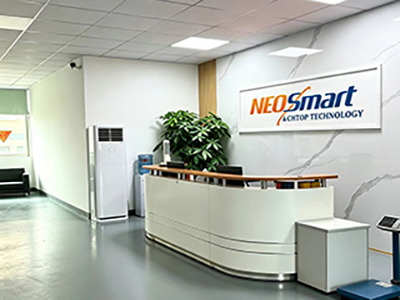
Chtopaccess Intelligent's Shenzhen plant — we build turnstiles, and we hope this guide saves you a few detours
Turnstiles are among the most widely deployed products in access control — tripod turnstiles, flap barriers and full-height turnstiles turn up in office buildings, industrial parks, factories, stadiums and retail complexes. Search online and you will find hundreds of companies calling themselves manufacturers. Start talking to them and the gaps appear fast: the gate cannot do what the project needs, customization never materializes, and integration or after-sales debugging becomes a struggle. Judging a supplier by its website and a good-looking sample is how bad partnerships begin.
Here is the landscape, honestly. Several hundred companies in China sell turnstiles, but most are security or construction firms treating turnstiles as a side line. Perhaps 200 treat turnstiles as their core business and actually manufacture them. Remove the trading companies with no factory of their own and the non-source businesses with no international certifications, and a few dozen remain — roughly half in Shenzhen, the rest spread through Dongguan, Huizhou and Foshan. What follows is a four-step guide based on our own years in this industry.
Before you contact any supplier, answer four questions honestly. Customer profile — premium or entry-level market? Open signal linking? On-site installation? Service boundary — complete units or spare parts? Software integration? After-sales support? Internal capability — software, installation, industrial design, service technicians: what can you do in-house? Volume — one-off project or ongoing programme, and what is a realistic order quantity? Without those answers, everything downstream is guesswork.
Look for suppliers with export qualifications and genuine international trade experience. Google, B2B platforms and social media will surface them quickly. A practical filter: start with Shenzhen and the surrounding manufacturing belt, where roughly half of China's serious turnstile manufacturers are clustered. The goal at this stage is filtering noise, not picking a winner.
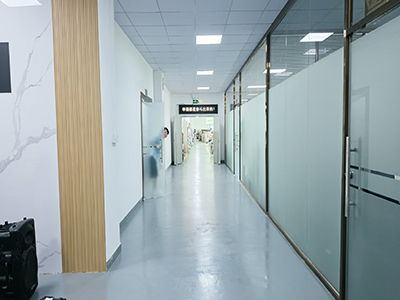
Workshop overview: full-process control from mechanism R&D to final assembly
The hard part is not whether candidates exist — it is which one will still be there in three years. Break it into three tiers.
Construction sites, temporary installations, basic open-and-close functionality, equipment to be discarded after a short period. Compare price, lead time and payment terms; whether the seller is a factory or a trading company hardly matters.
You assemble the gates yourself. Price is only half the equation — confirm the mechanism and control board are developed in-house. This matters more than most buyers realize: these parts are revised continuously, and finding an identical replacement five years later is nearly impossible outside the original manufacturer. Order customized samples, test them repeatedly, and run a small trial batch before mass production.
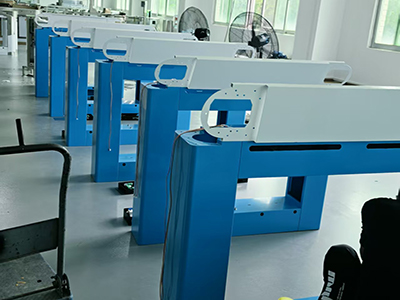
Mechanism workshop — in-house development and traceability are what make after-sales support actually work
You want long-term business and a more demanding market. The supplier has to check every one of these boxes: specialized in turnstiles, not carrying them as a side line; in-house R&D with self-developed mechanisms and control boards; real control over its own factory and production schedule; ecosystem literacy — knowing how the gate fits with pedestrian, vehicle and visitor systems; and customization-ready, flexible enough to follow project rhythm.
Also be wary of the "looks-like-a-factory" trap: pure assembly shops with no R&D, no proprietary boards, a handful of workers in an empty workshop. They open in waves and close in waves. Order transfers, suppliers going quiet, spare parts vanishing, payments cleared but shipping documents never arriving — every one of these has happened to overseas buyers.
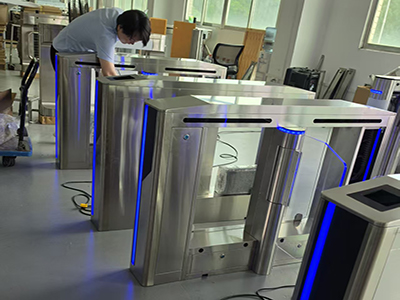
Every unit is powered on and tested before it leaves — skipping this is how every after-sales headache begins
Two turnstiles can look identical and still have completely different cost structures — which is why B2B listings run from under USD 100 to well over USD 1,000. The difference sits in the parts you cannot see at a glance: housing material thickness and surface treatment, mechanism design and materials, whether the control board is proprietary or an off-the-shelf reference design, motor and infrared sensor brand and service life, gate panel material, welding and cable quality, even the grade of the screws and the fixing-hole accuracy — plus the skill of the assembly team, which determines unit-to-unit consistency.
Experienced buyers learn where the differences are first, then issue a detailed specification, request a quotation, evaluate it, and only then negotiate. If your budget is tight, say so and let the factory adjust materials or processes. Chinese factories compete hard, and a long-term partner is unlikely to charge an unreasonable price.
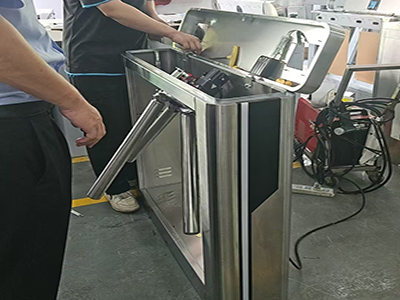
Tripod turnstile finished unit — what looks simple is mostly about internal component quality
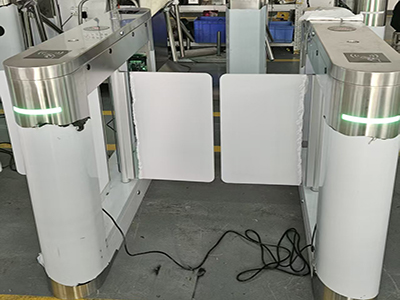
Flap barrier finished unit — beyond the housing, the mechanism is where lifetime cost lives
1. Define requirements — one-off or ongoing, target unit price, quality level, customer profile;
2. Shortlist — via Google, B2B, social media; talk, follow, then narrow. For long-term work, confirm in-house R&D;
3. Lock in the target — brief the sales engineer, get a quotation, negotiate, agree the technical solution;
4. Order customized samples — built to your real spec, not just the factory's stock;
5. Test — performance and customs clearance together;
6. Raise and solve problems — be direct, do not skirt issues;
7. Small trial batch — verify capacity, quality control, delivery, response;
8. Confirm long-term partner — not the cheapest, but the one that can walk the road with you.
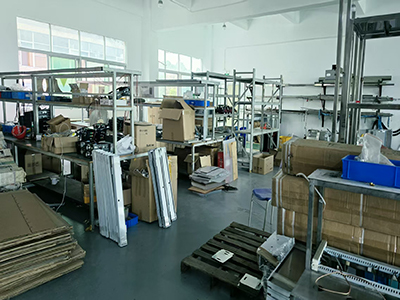
In-house warehouse — stock and dispatch discipline is what keeps your project on schedule
After years in this industry, our honest answer is simple: the right factory may look like luck, but it is almost always the result of doing the homework.
If you can, come and see the plant. China's entry visas are straightforward these days and the country is safe; an hour walking the workshop tells you more than a hundred emails.
— Chtopaccess Intelligent

Copyright @ 2026 Neosmart Chtop Technology All Rights Reserved.  Network Supported
leave a message
Scan to Wechat :

Scan to WhatsApp :